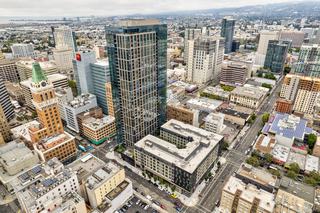
From century-old landmarks to Houdini’s daring escape, Downtown Oakland is packed with stories hiding in plain sight. Its mix of Beaux-Arts towers, Victorian survivors, and bold Art Deco façades reveals a city that’s always reinvented itself—from its 19th-century rail roots to today’s vibrant civic core.
- A 19th-Century Street Grid — Downtown Oakland’s distinctive angled grid was laid out in 1852 by surveyor Julius Kellersberger, whose diagonal cross-streets still define how Broadway and San Pablo Avenue intersect today.
- Railroad-Era Origins — When the western terminus of the First Transcontinental Railroad opened near Third Street and Broadway in the late 1860s, it triggered the move of Oakland’s commercial core northward. Today’s downtown blocks trace their origin to rail expansion.
- The Plaza with a Living Oak — Frank H. Ogawa Plaza, redesigned in 1998, centers on a single coast live oak, which is the city’s namesake tree. The plaza doubles as both civic forum and everyday gathering space framed by City Hall’s Beaux-Arts façade.
- Oakland’s Campanile: The Tribune Tower — Completed in 1923 and modeled after St. Mark’s Campanile in Venice, the 305-foot Tribune Tower mixes Spanish and Colonial Revival motifs; for decades, its illuminated clock and neon “TRIBUNE” sign defined the skyline.
- Who-Dini? — Tribune Tower’s Houdini moment: In 1923, Harry Houdini escaped from a straitjacket while dangling outside the tower—a stunt that cemented the building as a local icon.
- The Rotunda’s Grand Glass Dome — Formerly Kahn’s Department Store, this 1912 Beaux-Arts landmark dazzles with a 120-foot elliptical glass dome, marble staircases, terrazzo floors, and ornate plasterwork—an early symbol of Oakland’s prosperity.
- Art Deco + Beaux-Arts Masterpieces — The downtown area contains one of the West Coast’s richest concentrations of Art Deco and Beaux-Arts commercial buildings (especially around the 1920s uptick). You’ll find decorative friezes, curved windows, bold geometric façades and terra cotta detail around 14th and Broadway.
- Victorian Survivors in Old Oakland — Along 9th and Washington Streets, a preserved stretch of late-1800s storefronts reveals intricate cast-iron façades, tall bay windows, and upper-floor balconies that once lined the city’s original business corridor.
- City-Building by Design — Four master plans—the Kellersberger Survey (1852), Robinson Plan (1906), Hegemann Report (1915), and Bartholomew Plan (1928)—each reshaped downtown’s form, leaving traces in its plazas, boulevards, and transit links.
- A Mixed-Use Core That Never Slept — Unlike many city centers emptied by suburban flight, Downtown Oakland retained its blend of offices, housing, retail, and civic uses—creating the dense, walkable energy it’s known for today.
- Where Transit Meets Street Life — Two BART stations, historic Key System roots, and a pedestrian-scaled grid make downtown one of the Bay Area’s most connected urban centers—built for trains, and now reimagined for people.
- Historic "Old Oakland" —In what’s now the historic “Old Oakland” section of downtown, a row of Victorian-era commercial buildings was rescued in the 1970s-1980s and restored. Now, the district evokes how the district looked in the late 1800s when it was the region’s upscale business corridor.
- The Latham Square Fountain (1913) — A humane-movement memorial that once watered horses, people, and dogs—look for the basins at its base. It anchors the confluence of Broadway and Telegraph.
- The Nation's First High-Rise City Hall — Completed in 1914, Oakland City Hall rises 320 feet and was also the tallest building west of the Mississippi when completed.